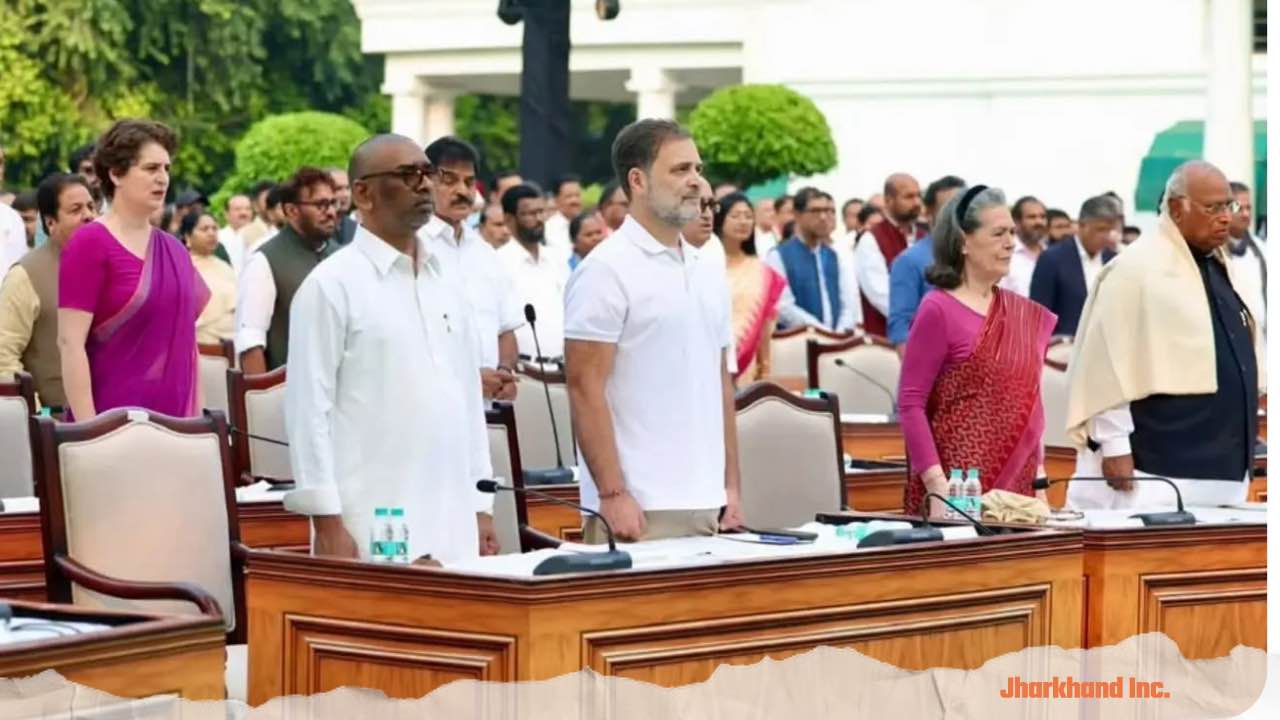
The photographs from the INDIA bloc’s mock parliamentary proceedings in Delhi on October 31 offered an interesting political picture. Hemant Soren, Jharkhand’s chief minister and executive president of the Jharkhand Mukti Morcha (JMM), was seated prominently beside Rahul Gandhi. The image conveyed political proximity at a time when opposition parties were attempting to present a united front against alleged irregularities in the electoral process and the Special Intensive Revision (SIR) of electoral rolls.
The following day, the INDIA bloc held its ‘Vote Bachao, Desh Bachao’ rally at Ramlila Maidan. Soren participated in the programme, but his public prominence appeared less pronounced than in the previous day’s photographs.
The contrast raises a larger question. Is Soren content with being a regional partner in a national opposition alliance, or does he want to establish a political identity that carries weight beyond Jharkhand?
The answer may lie not in any desire to distance himself from the INDIA bloc, but in the political space he wants to occupy within it.
A partnership, not a political merger
The JMM-Congress relationship is not simply an arrangement of electoral convenience. The two parties came together ahead of the 2019 Jharkhand Assembly election, with Rahul Gandhi and Soren working towards an alliance that eventually formed the basis of the state government. The partnership continued through the 2024 election.
For Soren, the alliance offers access to a national political platform, parliamentary influence and a wider opposition network. For Congress, the JMM is an important regional partner in a state where tribal identity, land rights and resource politics remain central to electoral outcomes.
But an alliance does not automatically imply political subordination.
The JMM has its own history, political constituency and ideological foundations. It emerged from the movement for a separate Jharkhand state, shaped by struggles over tribal identity, land, forests, mineral resources and regional self-determination. Its political inheritance is inseparable from the movement led by Shibu Soren.
That history gives the party an identity independent of Congress. For Hemant Soren, preserving that identity is both a political responsibility and an electoral necessity. The JMM must be seen as an equal partner, not merely a regional component of a national coalition.
Opposing the BJP without becoming Congress-dependent
There is little ambiguity about the JMM’s political contest with the BJP in Jharkhand. The two parties represent competing political narratives on tribal rights, land, identity and the distribution of political and economic power.
However, opposing the BJP does not require Soren to adopt every political position or priority of Congress.
His political calculations are rooted primarily in Jharkhand. The state’s mineral wealth, royalty and financial claims, tribal welfare, employment and the rights of local communities are issues that can bring the chief minister into confrontation with the Centre, irrespective of which party governs it.
A chief minister must engage with the Union government on financial transfers, infrastructure, welfare programmes and constitutional responsibilities. Such engagement should not automatically be interpreted as political accommodation. Equally, raising state-specific demands does not require abandoning an opposition alliance.
Soren’s challenge is to maintain both relationships: a working partnership with Congress and an independent position on issues where Jharkhand’s interests demand it.
But political independence must be demonstrated through consistent positions and measurable outcomes. If Jharkhand’s interests are invoked only when politically convenient, the argument for a distinct regional identity will remain unconvincing.
Jharkhand can offer a larger national argument
Soren’s national relevance ultimately depends on what he represents at home.
Jharkhand is not simply another state in the INDIA bloc’s electoral arithmetic. It raises questions with national significance: who controls natural resources, how mineral-producing states are compensated, what protections tribal communities receive, and how development can be reconciled with land and forest rights.
These concerns connect Jharkhand to other resource-rich and tribal-populated states, including Odisha, Chhattisgarh and parts of Madhya Pradesh and Maharashtra.
Soren could use this political space to build a larger federal argument. Instead of limiting his national role to attending opposition rallies or endorsing Congress leadership, he could articulate a distinct position on resource federalism, tribal rights and the economic claims of mineral-producing states.
His engagement with national institutions, including the NITI Aayog, is relevant in this context. His reported demand for the settlement of Jharkhand’s pending financial claims illustrates how state-level concerns can become part of a wider debate on Centre-state relations. Such demands, however, must be judged by their documentary basis, financial justification and follow-up, not merely by their political presentation.
A credible national position requires more than raising demands. It requires building arguments, finding allies among other states and demonstrating that Jharkhand’s concerns have implications for India’s federal structure.
That is an opportunity Soren has yet to fully develop.
A third space, not a third front
It would be premature to interpret Soren’s approach as an attempt to create a third political front. The JMM remains a partner of the INDIA bloc, and there is no clear evidence that the party intends to abandon that arrangement.
The more plausible interpretation is that Soren wants a distinct political space within the opposition.
This is not equidistance. The JMM is allied with Congress and remains a principal opponent of the BJP in Jharkhand. But Soren may not want his political identity to be defined entirely by either national party.
Regional parties face a structural dilemma. Their national influence grows through alliances, but their state-level credibility depends on demonstrating that they can protect their own political interests. Excessive dependence on a national partner can weaken their independent appeal. Excessive distance can reduce their influence in national decision-making.
There is also a less ambitious explanation for Soren’s positioning. His emphasis on Jharkhand’s interests may simply reflect the responsibilities of a chief minister governing a state with distinctive economic and social concerns. Not every state-specific intervention needs to be interpreted as a carefully designed national strategy.
Yet the political opportunity is real. Soren can turn the responsibilities of state leadership into a wider national argument if he chooses to do so.
The 2029 test
The next major test will be whether the JMM can convert its regional mandate into a stronger national presence without diluting its Jharkhand-centred character.
The JMM’s historical legacy and the state’s distinctive political experience provide a foundation. But history alone cannot sustain regional leadership. The government must demonstrate that its politics of identity and regional rights translates into better public services, employment opportunities, stronger local institutions and a fairer distribution of the benefits generated by natural resources.
Without such outcomes, the claim to represent a distinct model of regional politics risks becoming an electoral slogan.
The INDIA bloc needs regional leaders who bring more than electoral numbers to its campaigns. Leaders such as Soren can contribute distinct social constituencies, regional perspectives and federal concerns. But that contribution will matter only if they retain their political individuality.
Ultimately, the question is not whether Hemant Soren is closer to Rahul Gandhi or keeping his distance from Congress. It is whether he can build a political identity rooted in Jharkhand that carries weight beyond it.
His most credible national role may not be as another leader in the shadow of a national party, nor as the architect of an alternative front. It may be as the representative of a regional political force willing to work with the opposition while retaining the freedom to speak for its own state.
For Soren, the real political ambition may be neither to move away from the INDIA bloc nor to disappear into it. It is to remain a partner without becoming a subordinate, and to make Jharkhand’s voice matter in national politics on its own terms.