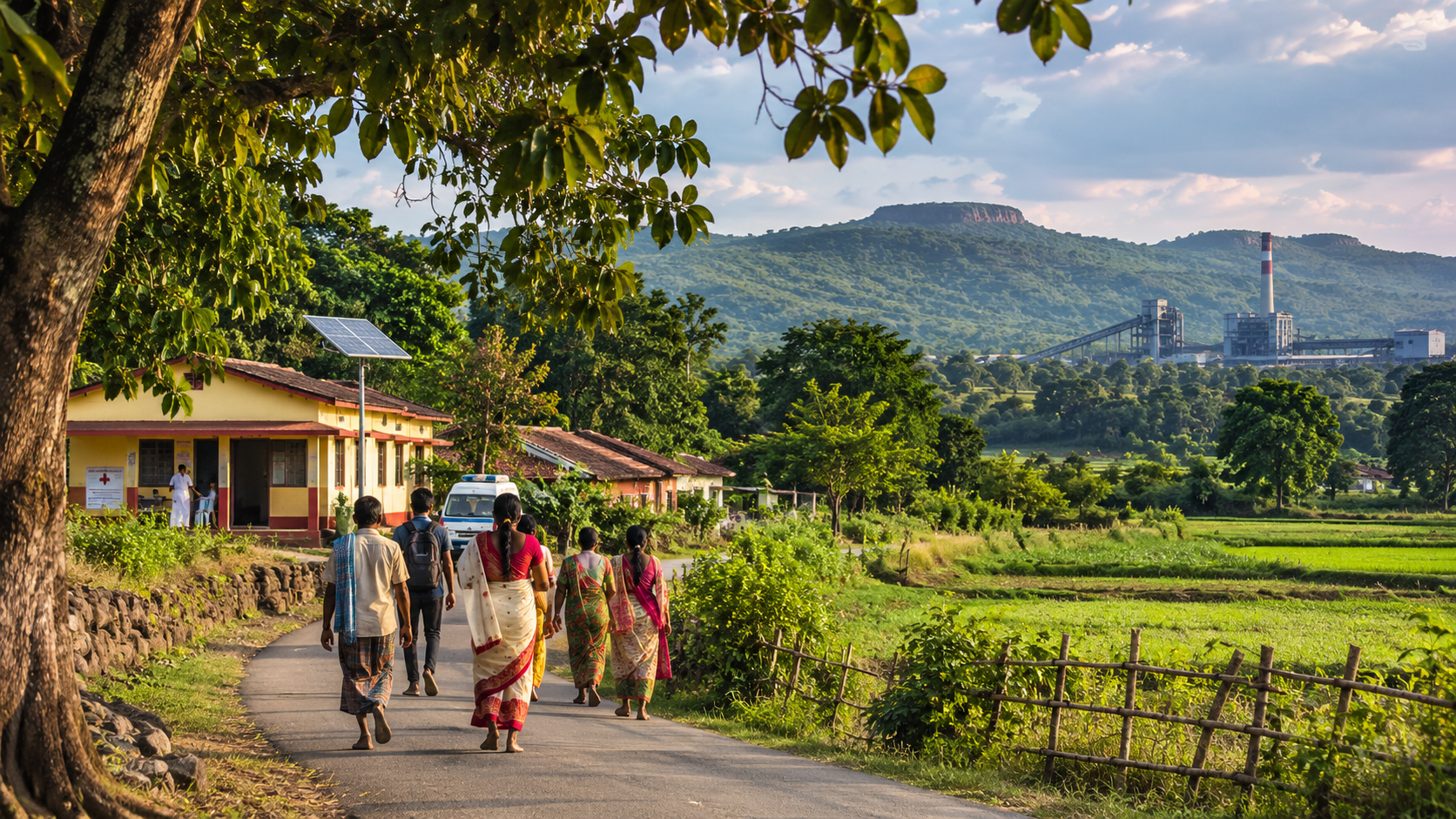
One year after Chief Minister Hemant Soren unveiled Ulgulan 2050, Jharkhand has taken steps on tribal self-governance, investment promotion and technology-led development. But the state’s own economic and social indicators underline the distance between a long-term vision and outcomes in jobs, education, healthcare and public services.
Launched on November 11, 2025, as Jharkhand marked 25 years of statehood, Ulgulan 2050 sets out a 25-year roadmap for a more self-reliant and equitable state. Its central promise is to move beyond an economy centred on extraction by building human capital, processing more natural resources within the state and strengthening community participation in development.
The vision places education, healthcare, youth employment, women’s economic participation, tribal rights and environmental protection alongside industrial growth. The test, a year later, is whether the policy direction is translating into measurable improvements in people’s lives.
From mineral extraction to local jobs
One of the roadmap’s principal economic objectives is to retain more value from Jharkhand’s mineral and agricultural resources. The state wants to encourage processing and manufacturing within its borders, support local enterprises and prepare young people for emerging sectors, including artificial intelligence, robotics, logistics and other technology-driven industries.
The logic is straightforward: extracting a mineral is only the first stage of an economic chain. Processing, manufacturing, transport and related services can create additional investment and employment. If these activities take place outside Jharkhand, much of the value addition and the associated jobs may also accrue elsewhere.
The 2026-27 state Budget provides for net expenditure of Rs. 1,50,106 crore and capital outlay of Rs. 24,791 crore. The government has also estimated Rs. 14,656 crore in revenue from the cess on mineral-bearing land. These are significant fiscal provisions and estimates, but they do not by themselves establish how much new productive capacity or local employment has been created.
That distinction matters. An investment proposal is not an investment realised; a signed agreement is not an operational plant; and a skills certificate is not a job. A meaningful review of Ulgulan 2050 must track projects that have reached implementation, capital actually deployed, units that have begun production and the number and quality of jobs secured by local residents.
In July 2026, the state held a national stakeholders’ consultation in New Delhi on investment, information technology, artificial intelligence and digital governance. Policy concept papers, including a proposed AI policy and investment-related measures, were presented for discussion. The exercise signalled an effort to widen Jharkhand’s economic base, but the proposals will need to move through policy adoption, investment decisions and implementation before their impact can be assessed.
Education: access has improved, retention remains a concern
Ulgulan 2050 promises universal education, stronger government schools, better teacher capacity and learning in tribal languages such as Santali, Mundari and Kurukh. The emphasis on mother-tongue learning recognises that language can shape a child’s early experience of education, particularly in areas where the language spoken at home differs from the language used in school.
The Jharkhand Economic Survey 2025-26 puts the state’s literacy rate at 76.7 per cent in 2023-24, compared with 53.56 per cent in the 2001 Census. The improvement is substantial, but the rate remains below the national average of 80.9 per cent.
The survey points to a more serious challenge in school retention. Its student-pipeline analysis indicates that, for every 100 students entering the preparatory stage, only 19.7 complete the secondary stage in Jharkhand, compared with 31.2 nationally. The secondary-level dropout rate is reported at 15.2 per cent. The pupil-teacher ratio in the state’s government school system is 36, against a national average of 24.
These indicators suggest that enrolment and literacy gains need to be matched by better learning outcomes, adequate staffing and a stronger transition from middle to secondary education. The challenge is particularly important for tribal students: the survey reports a sharp decline in the Scheduled Tribe gross enrolment ratio between the preparatory and secondary stages.
Health gains need stronger delivery on the ground
The economic survey records improvement in key maternal and child health indicators. Jharkhand’s maternal mortality ratio declined to 54 per 100,000 live births, while the infant mortality rate stood at 25 per 1,000 live births. Institutional deliveries reached 85.7 per cent in 2024.
These figures point to progress in access to maternal and child healthcare. They do not, however, remove concerns over the availability of doctors and specialists, nutrition, rural health infrastructure and the affordability of treatment. The presence of a hospital building does not guarantee that patients have access to doctors, medicines, diagnostic facilities and timely care.
Ulgulan 2050’s promise of stronger primary healthcare and better-equipped hospitals will therefore have to be measured through service availability and patient outcomes, not infrastructure announcements alone.
PESA rules put community governance in focus
One of the clearest institutional developments during the year was the notification of the Jharkhand Panchayat Extension to Scheduled Areas (PESA) Rules, 2025. The state government issued the notification on January 2, 2026, providing a framework for the functioning of Gram Sabhas in Scheduled Areas.
The rules are relevant to Ulgulan 2050’s emphasis on community-led development and the protection of land, water, forests and local resources. Their significance will depend on how effectively Gram Sabhas are informed, equipped and involved in decisions, and whether administrative authorities respect the roles assigned to them.
Notification is an important first step, but implementation is the real test. The state will need to demonstrate how the rules are being applied in villages, how community participation is being recorded and how disputes or disagreements over local resources are addressed.
Development must protect land, forests and livelihoods
Jharkhand’s development choices carry a particular responsibility because mining and industrial projects can affect forests, water sources, agricultural land and communities whose livelihoods depend on them. Ulgulan 2050 recognises the need to combine economic growth with environmental safeguards and the protection of tribal identity.
The issue is not whether industrial development and tribal rights must compete. The question is whether projects can create local employment and public revenue while ensuring lawful processes, meaningful community participation, fair rehabilitation and restoration of environmental damage.
For tribal and particularly vulnerable tribal communities, access to quality education, healthcare, nutrition, housing and livelihoods must advance alongside the protection of individual and community rights under existing laws. Development that weakens the resource base or displaces communities without restoring livelihoods would fall short of the vision’s stated objectives.
The 2030 test: publish outcomes, not just announcements
The year 2030 should become the first major checkpoint for Ulgulan 2050. The state needs clear, measurable interim targets for school retention, teacher availability, health services, local employment, industrial production, drinking water, irrigation and the implementation of PESA and forest rights.
A public annual progress report, supported by district-level data, would allow citizens to compare commitments with delivery. It should distinguish between proposals, approvals, funds allocated, money spent, projects completed and outcomes achieved. Employment figures should identify how many jobs went to local residents and whether they are stable and adequately paid.
One year after its launch, Ulgulan 2050 remains a broad statement of direction rather than a completed programme whose impact can be judged as a whole. There are identifiable steps, including the PESA notification, budgetary provisions and consultations on technology and investment. At the same time, the education data shows persistent gaps, while budget estimates and policy proposals cannot substitute for evidence of jobs and improved services.
Jharkhand’s future will not be determined only by the scale of its mineral reserves, industrial projects or government allocations. It will depend on who benefits from those resources, whether local communities have a meaningful voice in decisions and whether growth improves everyday life across districts.
The promise of Ulgulan 2050 will ultimately be judged not by the ambition of its 2050 destination, but by the progress the state can demonstrate by 2030.