


Heritage
National honour, local struggle: The Simdega hockey story
Manoj Konbegi’s national honour is also a recognition of Simdega’s long, under-told hockey journey. A Jharkhandinc feature on talent, struggle and sporting identity.

There are some stories in Jharkhand that rarely begin in stadiums.
They begin in red earth fields, in villages where hockey sticks are often older than the players holding them, in homes where sport is not a career plan but a stubborn act of faith. They begin in districts that are more often described through the language of deprivation, migration, underdevelopment or conflict than through the language of excellence.
And yet, year after year, one such district has continued to send players into the national imagination.
That district is Simdega.
For decades, Simdega has carried a sporting truth that the rest of India notices only in flashes, usually when one of its daughters or sons wears the national colours. In between those moments of recognition lies a much longer and harder story, one built not by headlines, but by repetition: practice grounds, local tournaments, travel struggles, financial uncertainty, family sacrifice, and the labour of people who kept believing that talent from Jharkhand did not need sympathy, only support.
Today, that long and largely uncelebrated work found a national stage.
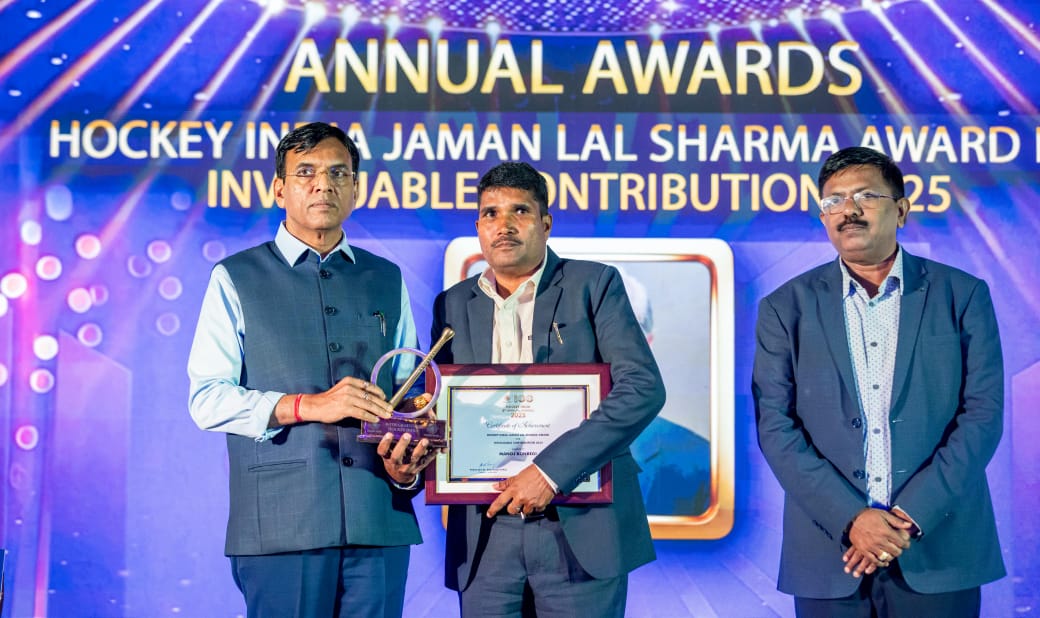
At Hockey India’s 8th Annual Awards 2025 in New Delhi, Manoj Konbegi, one of the central figures in Simdega’s hockey journey, was conferred the Jaman Lal Sharma Award. On paper, it is an individual honour. In truth, it is recognition of something much larger: the building of a hockey culture in a district that has produced player after player, often with less infrastructure than many places that produce far less.
Konbegi’s recognition matters because it points to a question Jharkhand has lived with for years: how does a place with so little keep producing so much?
The answer lies partly in geography, partly in culture, and largely in persistence.
A district that kept producing despite the odds
Simdega’s relationship with hockey is not recent, nor accidental. The sport is woven into the district’s social life in a way that outsiders often misunderstand. In many villages, hockey has long been more than a game. It has been aspiration, identity, community memory and, for some, one of the few visible routes to mobility.
This is not a story of sudden discovery. It is a story of continuity.
Across the district, generations have grown up with local grounds that double as social spaces, with tournaments that carry the emotional energy of festivals, and with a sporting instinct passed from one age group to another. Long before policy documents began using terms like “grassroots development” and “sports ecosystem”, Simdega had already been living that model in fragments, held together by habit and local commitment.
But culture alone does not produce national players.
Talent may emerge naturally, but careers do not. Between a gifted child in a village and a player in India colours lies a long corridor of selection, travel, nutrition, equipment, training, confidence and survival. It is in that corridor that many stories collapse. And it is in that corridor that people like Manoj Konbegi have mattered.
The work between talent and recognition
Konbegi’s contribution cannot be understood merely through designation or ceremony. He is currently the president of Hockey Simdega and vice-president of Hockey Jharkhand, but his significance lies less in title and more in function.
For nearly two decades, he has been part of the local architecture that keeps the sport moving, often quietly and often without visibility. That has meant organising tournaments at the rural level, helping players remain connected to competition, supporting them in moments of financial or logistical difficulty, and ensuring that local talent is not lost to neglect before it is even noticed.
That kind of work rarely appears in the public record. It does not usually produce viral moments. But in districts like Simdega, it is often the difference between a player dropping out and a player staying in the game.
At the Hockey India awards ceremony, a presentation on Konbegi’s work reportedly referred not just to individual contribution, but to the larger role of local support, administrative backing and community participation in helping players from the district move to higher levels of competition. That framing is important, because no sporting landscape is built by one person alone. But equally, some people become the connectors through whom fragmented systems begin to function.
That is often the real work in Jharkhand: not building from abundance, but stitching continuity out of scarcity.
When Delhi noticed what Simdega already knew
The award itself came during Hockey India’s centenary year celebrations in New Delhi, where Konbegi received the honour from Union Minister Mansukh Mandaviya and Minister of State for Youth Affairs and Sports Raksha Nikhil Khadse. He also received a cash prize of Rs 5 lakh.
The event was attended by Hockey India president and Olympian Dilip Tirkey, secretary general Bholanath Singh, treasurer Manohar J Shekaran, secretary Commander RK Srivastava, selection committee member Asunta Lakra, Hockey Jharkhand general secretary Vijay Shankar Singh, members of the Indian men’s and women’s teams, former Olympians and others.
But beyond the official list, the symbolism of the moment mattered more.
For Simdega, the recognition was not simply about one man receiving one award in the capital. It was about a district seeing a part of its long labour acknowledged at the national level. In states like Jharkhand, where many stories remain peripheral until they are validated elsewhere, such moments carry their own emotional charge.
Konbegi, in his response, placed the honour where it belonged.
“This honour is dedicated to the players, officials and people associated with hockey in Simdega. There is talent here and it needs continued support,” he said.
That statement is both gratitude and diagnosis.
Because Simdega has never really lacked talent. What it has lacked, repeatedly, is sustained and structured support.
The players are the proof
If one wants to understand the scale of Simdega’s contribution, one only has to look at the names that have emerged from its soil.
Salima Tete, Sangeeta Kumari, Beauty Dungdung, Ropni Kumari, Tarini Kumari and Deepika Soreng are among those who have carried Simdega into wider recognition. Behind each such name lies a chain of unseen effort: family adjustment, local encouragement, school and training compromises, and the labour of a district that keeps feeding the game.
This is why Simdega is often described as a hockey nursery. But even that phrase can become too neat if repeated without reflection.
A nursery suggests care, planning and infrastructure. In reality, Simdega has often had to produce excellence with only partial systems in place. That makes its output less romantic, and more politically revealing.
It tells us something uncomfortable about Indian sport: that some of the country’s most reliable talent pipelines survive not because the system works well, but because communities keep compensating for where the system falls short.
A wider moment for Jharkhand hockey
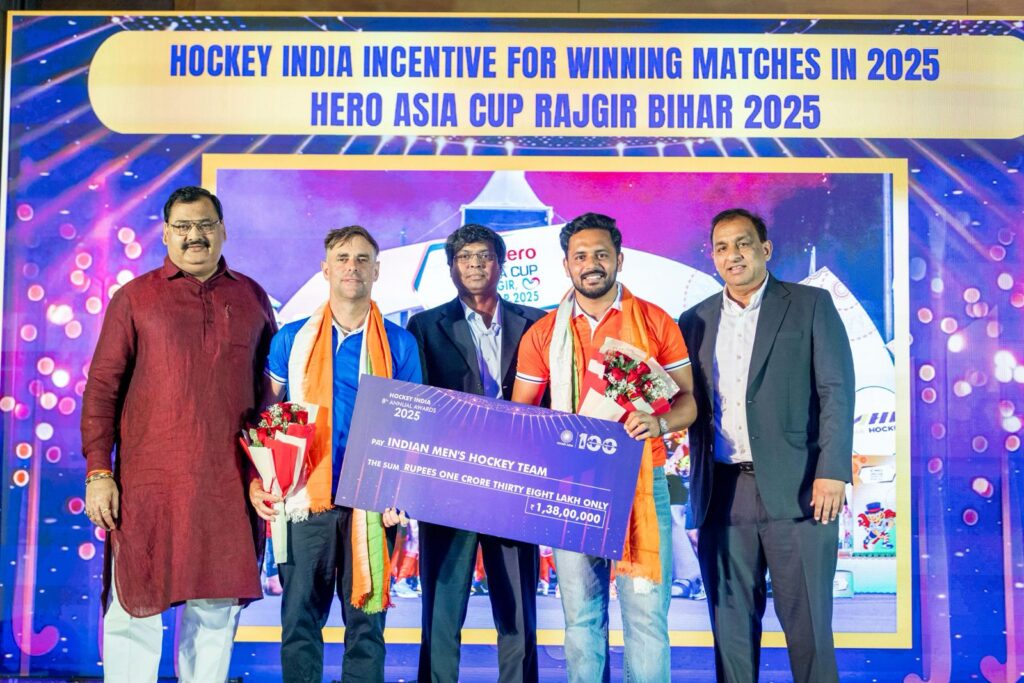
The same ceremony also brought another recognition for the state. Hockey Jharkhand received a cash award of Rs 10 lakh after the state’s sub-junior, junior and senior teams won gold medals in national competitions in 2025. The award was received by Vijay Shankar Singh.
That matters too.
Because while individual honours draw attention, institutional results tell their own story. Jharkhand’s performance across age categories shows that the state’s hockey strength is not confined to isolated stars. There is depth in the pipeline. There is continuity in talent. There is enough evidence now to say clearly that Jharkhand, and Simdega in particular, is not an incidental contributor to Indian hockey. It is one of its sustaining sources.
And yet, the old question remains: if so much has already been produced, why does the support structure still feel so limited compared to the scale of output?
What this honour should force us to ask
The easiest way to read this story is as a feel-good regional success. But that would be incomplete.
The harder, and more necessary, reading is this: why do places like Simdega still have to fight so hard to be seen, even after repeatedly proving their value?
Why are districts that have already delivered for the country still waiting for the level of infrastructure, planning and long-term investment that should have followed years ago? Why does recognition so often arrive after struggle, instead of support arriving before it?
These are not questions for ceremony. They are questions for policy.
Because if Simdega has done this much with limited means, then the real story is not only what it has achieved. It is what it could become if it were backed with seriousness.
For now, though, Delhi has at least acknowledged something Simdega has known for a long time.
That its hockey story was never accidental. It was built. Quietly, stubbornly, over years. And this week, for a brief moment, the country looked in its direction.




Jharkhand pushes innovation agenda

Ranchi turns vertical


