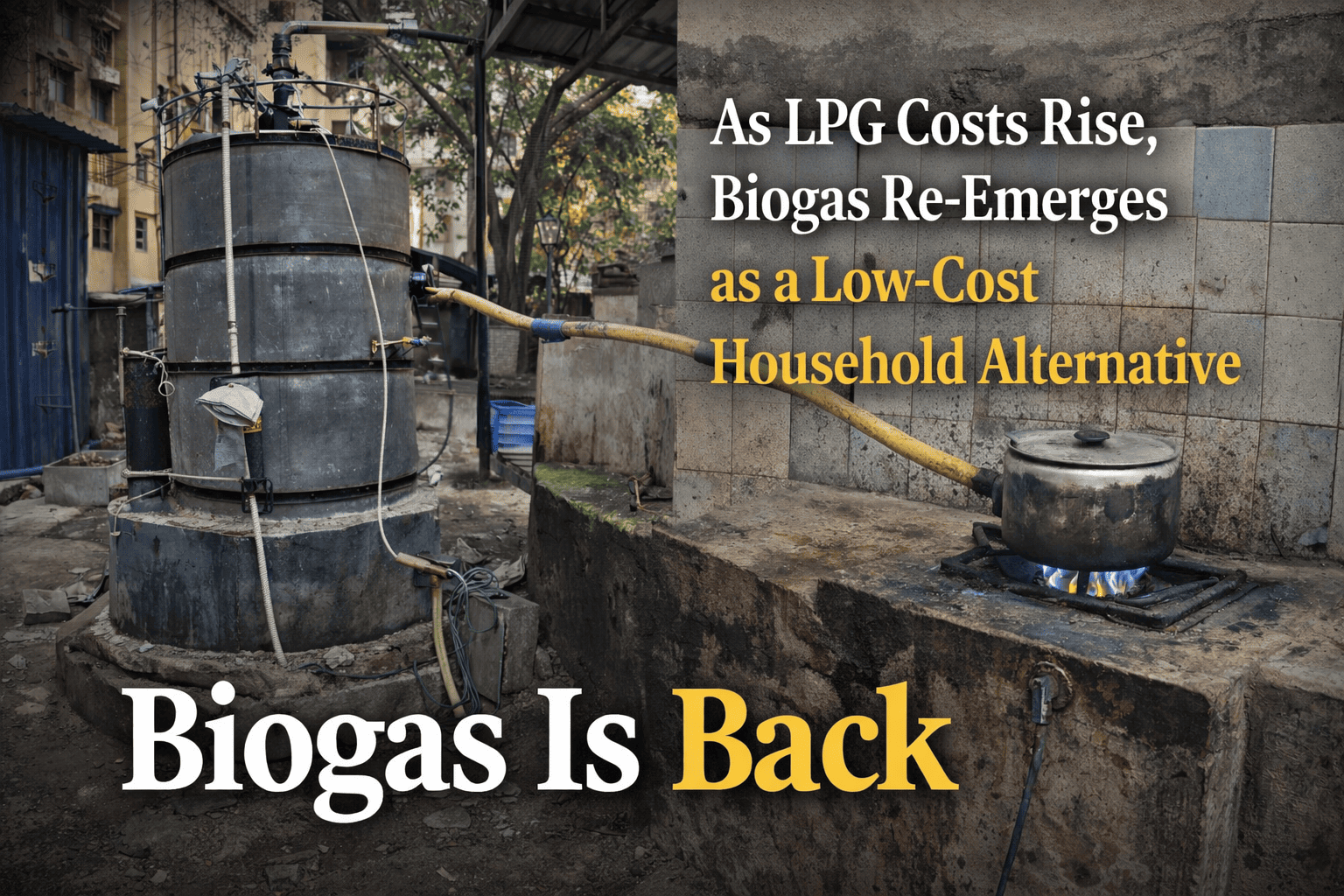
As cooking gas prices continue to strain household budgets, older low-cost energy models such as biogas are quietly finding renewed relevance in and around Ranchi.
A recent example has emerged from BIT Mesra, where a biogas model developed from organic waste is demonstrating how traditional fuel alternatives can still offer practical value in today’s energy-stressed environment.
The project, built around the idea of converting biodegradable waste into usable cooking gas and organic manure, is once again drawing attention to a technology that had once faded from mainstream household planning.
An old idea, made useful again
The core idea behind biogas is simple: organic waste such as cow dung, kitchen waste and biodegradable residue is decomposed in a controlled chamber to produce methane-rich gas that can be used for cooking.
At BIT Mesra, the model reportedly shows that around 250 kilograms of waste can produce approximately 35 to 40 cubic metres of biogas per day, with the potential to generate gas equivalent to nearly 60 domestic LPG cylinders in a month.
That makes the model significant not merely as a campus experiment, but as a possible indicator of how decentralised energy systems could reduce household dependence on conventional LPG in certain contexts.
Why this matters now
This renewed interest in biogas is not accidental.
Across urban and semi-urban India, the rising cost of LPG cylinders has pushed many families to rethink fuel use, especially in lower and middle-income households where cooking energy remains a recurring financial pressure.
In that backdrop, biogas is returning not as a romantic village-era solution, but as a cost-sensitive, locally manageable and environmentally useful alternative.
Its appeal lies in three things:
- it uses locally available waste
- it can reduce fuel expenditure
- and it produces organic manure as a by-product
That gives it an advantage in both household and institutional settings.
The Mansar House example
The report also points to the example of Mansar House, where a kitchen is reportedly being run using gobar gas, showing that small-scale biogas systems can function in real-life settings beyond demonstration projects.
This is important because one of the biggest weaknesses of alternative energy ideas in India is that they often remain limited to seminars, pilot projects and government brochures.
When such systems are seen working in actual kitchens, their credibility changes.
Can this work beyond a few model sites?
That, however, is the bigger question.
Biogas has long been known in India, but its adoption has remained limited because of:
- space constraints in urban homes
- maintenance concerns
- irregular waste input
- lack of technical support
- and the perception that it is a “rural-only” solution
For it to become viable at scale in Jharkhand, the model would need support through:
- housing-linked small biogas designs
- municipal organic waste collection systems
- technical handholding
- community-level adoption in apartments, hostels and institutions
- and public awareness around its economic benefits
More than an energy story
This is not just a fuel story. It is also a waste management story, a cost-of-living story, and a sustainability story.
If developed seriously, biogas can sit at the intersection of:
- urban waste reduction
- cleaner household fuel
- organic farming support
- and decentralised local energy
That makes it far more relevant than it is usually treated.
Jharkhandinc View
Biogas is not a magic answer to India’s LPG challenge.
But it may well be one of the most underused practical answers available at the local level.
The real test is whether Jharkhand treats such models as isolated curiosities, or as early templates for a more affordable and sustainable household energy future.
Because sometimes, the most useful solutions are not the newest ones.
They are the ones we stopped taking seriously too soon.