Rs 469 crore flyover, Rs 351 crore more: Is Ranchi finally ready for an elevated future?
Ranchi is beginning to look up.
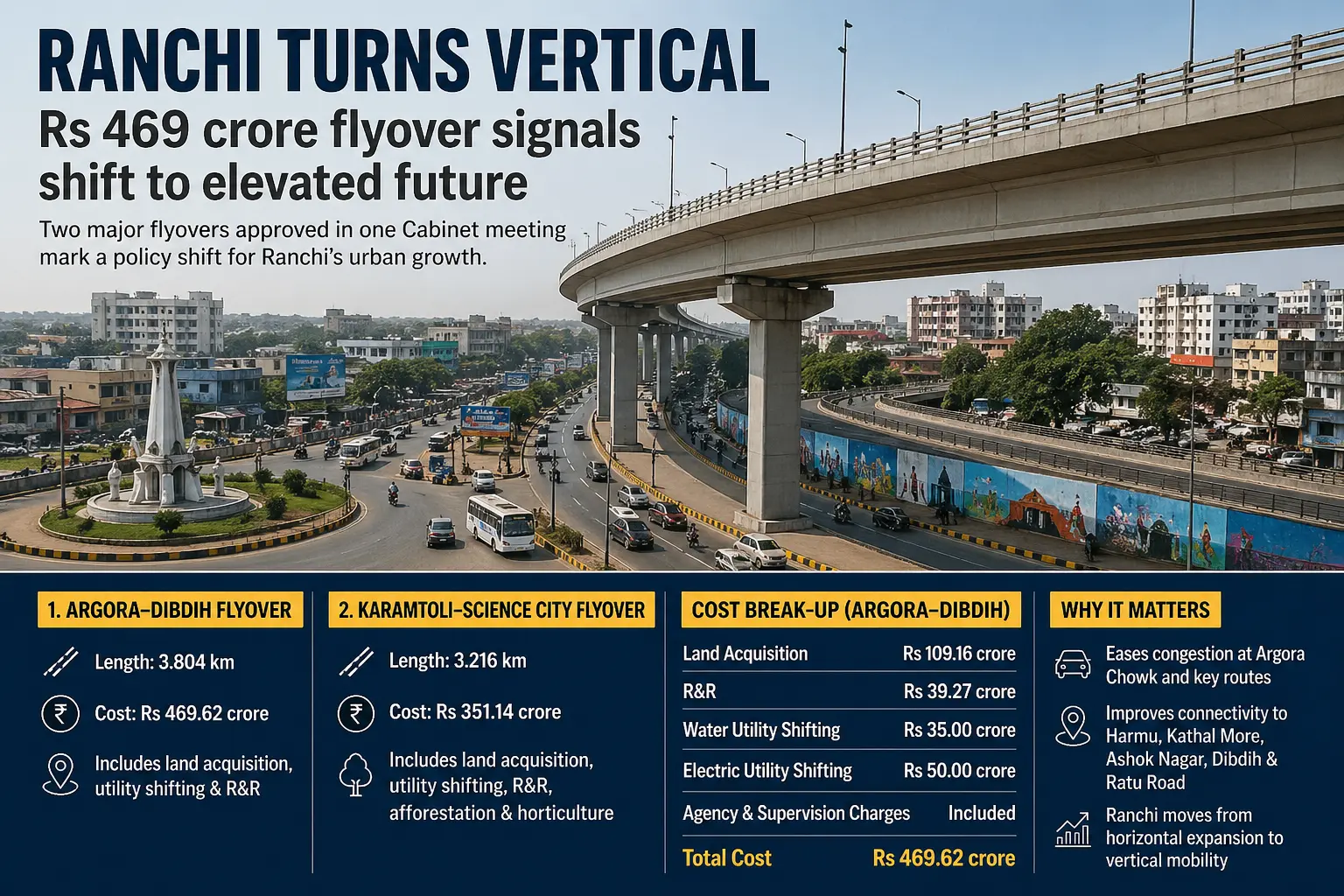
In a single Cabinet meeting, the Jharkhand government approved two major elevated road projects: a Rs 469.62-crore corridor from Argora Chowk to Dibdih bridge, and another Rs 351.14-crore flyover from Karamtoli to Science City. On paper, these are infrastructure decisions. In reality, they signal something deeper. Ranchi is quietly transitioning from a city that expanded outward to one that now has no option but to grow upward.
For years, the capital stretched horizontally. New colonies, wider roads, and peripheral growth carried the burden of expansion. That model is now under strain. Traffic density has increased, land availability has tightened, and key junctions have turned into daily bottlenecks. Argora Chowk is one of the most visible examples of this pressure.
The proposed Argora–Dibdih elevated corridor, stretching about 3.8 km, is not just another flyover. It sits at the intersection of multiple high-traffic routes. Harmu, Ashok Nagar, Kathal More and adjoining areas feed into this junction. The road network below has limited room to expand. A flyover, in this context, is less a choice and more a compulsion.
But the shift to elevated infrastructure comes with its own set of questions.
The cost of going vertical
At Rs 469.62 crore for 3.8 km, the project works out to well over Rs 120 crore per kilometre. That places it in the higher band of urban flyover costs. The number, however, tells only part of the story.
A significant portion of the expenditure lies outside core construction. Land acquisition alone is estimated at around Rs 109 crore. Rehabilitation and resettlement adds another Rs 39 crore. Then comes utility shifting, often the most complex part of urban infrastructure execution. Water pipelines account for about Rs 35 crore, while electrical lines add nearly Rs 50 crore.
Put together, these components form a substantial share of the total project cost. They also represent the most unpredictable part of execution.
Where projects slow down
If there is one consistent pattern across urban infrastructure projects in Indian cities, it is this: delays rarely come from construction alone. They emerge from what happens before and around it.
Land acquisition in dense urban areas is rarely smooth. Valuation disputes, relocation concerns, and administrative bottlenecks tend to stretch timelines. Utility shifting is equally challenging. Water lines, power cables, telecom networks all run beneath or along existing roads. Relocating them requires coordination across multiple agencies, each with its own constraints.
Ranchi has seen these challenges before. Road widening and drainage projects in key corridors have faced delays linked to exactly these issues. Elevated corridors reduce the need for widening, but they do not eliminate the underlying complexity of urban infrastructure work.
A pattern, not an isolated decision
The approval of a second flyover, from Karamtoli to Science City at a cost of over Rs 351 crore, reinforces the direction of policy. This is not a one-off response to congestion at a single junction. It is an emerging pattern.
Ranchi is moving towards grade-separated infrastructure. In simple terms, the city is beginning to separate traffic flows vertically rather than trying to manage everything on the same road surface.
This shift is common in cities that have reached a certain stage of growth. When land becomes scarce and traffic volumes rise beyond what surface roads can handle, elevated corridors, underpasses, and multi-level junctions become part of the urban vocabulary.
Necessity versus preparedness
The larger question is not whether Ranchi needs these flyovers. The pressure points are visible enough. The question is whether the city is institutionally prepared to execute them efficiently.
Projects of this scale demand tight coordination between departments, clear timelines, and consistent monitoring. Even a small delay in one component can cascade into larger cost and time overruns.
There is also the question of integration. A flyover solves congestion at one level, but its effectiveness depends on how well the connecting roads handle the redistributed traffic. Without parallel improvements in feeder roads and traffic management, bottlenecks can simply shift from one point to another.
The city at a turning point
What the Cabinet decisions indicate is a recognition of reality. Ranchi can no longer rely solely on incremental road expansion. The city has entered a phase where structural interventions are required.
Elevated corridors are expensive, complex, and not without risk. But they are also, in many ways, inevitable for a city navigating growth pressures with limited space.
The success of this shift will not be measured by approvals alone. It will depend on execution, coordination, and the ability to anticipate challenges before they become delays.
Ranchi is beginning to build upward. Whether it can do so efficiently will define not just traffic flow, but the next phase of its urban evolution.