

Business & Industry
Chamber Charts Roadmap for Jharkhand’s Agri-Industrial Growth
The Federation of Jharkhand Chamber of Commerce and Industries’ AHARI Sub-Committee has proposed a comprehensive plan for agricultural growth. It calls for functional market committees, export infrastructure, expanded irrigation, and revival of dairy farming to strengthen Jharkhand’s rural economy and create new opportunities for farmers and entrepreneurs.


The AHARI Sub-Committee of the Federation of Jharkhand Chamber of Commerce and Industries (FJCCI) has urged the state government to take decisive measures to strengthen the agriculture sector through better market access, irrigation expansion, export infrastructure, and dairy development.

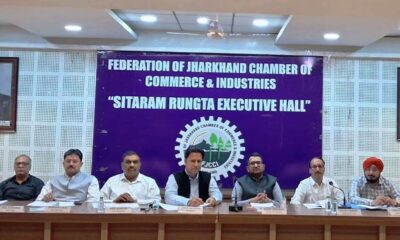
At a meeting held at the Chamber Bhawan, members including Vice Presidents Praveen Lohia and Ram Bangad, Secretary General Rohit Agrawal, Assistant Secretary Rohit Poddar, and Committee Chairman Anand Kothari discussed ways to unlock the state’s agricultural potential and make farming more remunerative for rural communities.
Reviving Market Committees and Direct Farmer Access
The committee pointed out that market committees across Jharkhand, originally created to safeguard farmers’ interests, are now largely defunct. It recommended that the state government restore direct purchase and sale facilities for farmers in these markets and ensure spaces for farmer offices and rest areas. The Chamber also called for the removal of departmental encroachments from market premises and full implementation of the APMC law so that farmers can access all related benefits.
Infrastructure for Agri-Exports
To enable Jharkhand to tap into global markets, members proposed developing an enabling ecosystem for agricultural exports. The Chamber sought the opening of an APEDA office in the state, international cargo facilities at Birsa Munda Airport, and the establishment of dry ports and integrated pack houses. These measures, they argued, would help farmers and agri-based enterprises access international buyers and reduce post-harvest losses.
Expanding Irrigation and Productivity
Chairman Anand Kothari expressed concern that despite receiving 1200–1600 mm of annual rainfall, only 15 percent of Jharkhand’s farmland is under assured irrigation even after 25 years of statehood. He recommended completing long-pending irrigation projects within a defined timeline and setting up a state-level task force to monitor progress. With a focused effort, he said, irrigation coverage could be raised from 15 to 50 percent in a few years.
Kothari also urged the government to start paddy procurement from December, increase procurement centers up to the panchayat level, and align the MSP with neighboring states like Chhattisgarh and Odisha. He emphasized timely payment to farmers to avoid distress sales.
Boosting Dairy and Rural Entrepreneurship
Members raised concern over the state’s dependence on milk imports despite suitable conditions for dairy farming. The Chamber proposed reviving earlier government schemes that promoted commercial dairy farms with 50 to 150 cattle units. Such programs, they said, could attract local entrepreneurs, generate employment, and build Jharkhand’s self-sufficiency in milk production.
Skill Development and Agri-Education
Recognizing the need for skilled manpower in dairy and allied sectors, the committee recommended that Birsa Agricultural University and the Industries Department collaborate to develop specialized training programs. Strengthening the proposed Dairy University and expanding practical courses could produce technically trained professionals ready to manage modern dairy farms.
A Collective Appeal for Policy Action
The meeting concluded with a joint appeal to the state government to take a time-bound approach to implement these measures. Members expressed hope that by addressing irrigation, market access, exports, and skill development together, Jharkhand can move towards sustainable rural prosperity and position agriculture as a driver of industrial and employment growth.









Jharkhand lays foundation for film talent pipeline with SRFTI partnership

Jharkhand to Establish First Film and Television Institute with SRFTI

Jharkhand’s Moment on the National Stage: Santhali Film Angen Wins 72nd National Film Award

Palash: How Jharkhand’s Women’s Collective Became a Global Case Study

India International Mega Trade Fair 2026 in Ranchi

Bokaro Thermal Power Plant Shut Down, DVC Faces Heavy Costs

From Welfare to Enterprise: How Rs 2,500 a Month Is Helping Women Build Businesses in Koderma

Jharkhand’s Solar Policy: Decentralised Energy in Practice
