In the shadow of the towering statue of Jamsetji Tata inside the Tata Steel works, the past and the future seemed to meet on Tuesday.
On the 187th birth anniversary of the founder, Natarajan Chandrasekaran, Chairman of Tata Group, addressed questions that could not have been imagined in Jamsetji’s time: artificial intelligence, geopolitical instability, global supply chains and workforce transformation.
Yet, at the heart of the conversation was a familiar theme. Growth, even in the age of AI, must remain anchored in people.
Global Tremors, Local Nerve Centre
Chandrasekaran said the ongoing Iran conflict has had no direct impact on the Tata Group or India so far. However, he cautioned that prolonged instability in West Asia could create challenges, particularly for supply chains and logistics.
The group imports limestone from the Middle East and operates across several geographies. Extended disruption, he noted, could affect delivery schedules and long-term sustainability.
For Jharkhand, this is not an abstract concern.
Tata Steel’s integrated plant in Jamshedpur is deeply embedded in global raw material flows, export markets and technology partnerships. Any sustained disruption in West Asia or global shipping lanes can ripple through procurement cycles, freight costs and project timelines.
What this underscores is a shift in Jharkhand’s industrial identity. The state is no longer a peripheral mining economy. Its flagship industrial assets are fully integrated into global networks. Decisions taken in Tehran or tensions in the Strait of Hormuz can, indirectly, influence production rhythms in Jamshedpur.
The corporate mood, as reflected in Chandrasekaran’s remarks, is cautious but not alarmist. There is no immediate disruption, but contingency planning is clearly in focus.
Workforce Expansion in an Age of Automation
If geopolitics framed the uncertainty, artificial intelligence framed the opportunity.
Chandrasekaran said the Tata Group’s workforce has grown from around five to six lakh over the past five to six years to nearly eleven lakh today. The target is to reach fifteen lakh employees by 2030.
This expansion plan comes at a time when automation and AI have triggered global anxiety over job losses.
Addressing such concerns, he acknowledged that apprehensions are natural with the arrival of new technologies. However, he argued that AI is expected to create new opportunities across steel, automobiles and finance. As enterprises integrate AI-driven solutions into their core operations, companies such as Tata Consultancy Services are likely to benefit from rising demand for digital transformation.
For Jharkhand, the question is sharper: is the state prepared to ride this wave?
Traditional heavy industry is increasingly becoming technology-intensive. Predictive maintenance, AI-based quality control, digital twins and automated logistics are no longer futuristic concepts. They are part of daily plant operations.
If Tata’s workforce is set to expand, the composition of that workforce will change. Mechanical skills will increasingly be complemented by data analytics, robotics maintenance, AI systems integration and digital process management.
This presents both a challenge and an opportunity for Jharkhand’s youth. Skill development institutions, engineering colleges and vocational training centres in and around Jamshedpur will need to align with this shift. The steel city, long seen as a manufacturing hub, could evolve into a hybrid industrial-tech ecosystem.
Women in Heavy Industry: A Structural Shift
Chandrasekaran also said the group is working to raise women’s participation in its workforce to 28 to 30 per cent.
In the context of heavy industry, this is a significant statement.
Manufacturing, mining and core engineering have traditionally been male-dominated sectors, especially in states like Jharkhand. Increasing women’s participation will require not only hiring targets but structural changes: safer shop floors, redesigned roles, flexible shifts, childcare infrastructure and inclusive leadership pathways.
For JharkhandInc, this is more than a diversity statistic. It signals a potential transformation in the state’s industrial culture. If Tata, as the largest industrial employer in the region, successfully expands women’s representation, it could influence ancillary industries and local suppliers.
Jamsetji’s early introduction of maternity benefits and childcare facilities in the nineteenth century was radical for its time. A century later, the push for gender inclusion in core industry could prove equally transformative.
Jamshedpur: A Living Industrial Laboratory
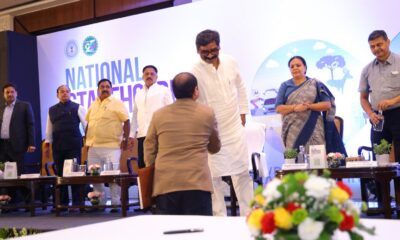
The anniversary ceremony was attended by Noel Tata and Tata Steel Managing Director and CEO T V Narendran. Floral tributes were paid at the statue within the plant and later at Postal Park in Bistupur.
The symbolism was not lost on observers.
Jamshedpur, earlier known as Kalimati and renamed in 1919 in honour of Jamsetji, remains one of India’s most planned industrial townships. Wide roads, green spaces and community infrastructure were embedded in its design long before urban planning became a policy buzzword.
Today, the city is also emerging as a testbed for digital manufacturing, sustainability practices and ESG-linked capital allocation.
Smart plant operations, energy efficiency drives and decarbonisation strategies are gradually redefining the steel ecosystem. If AI becomes central to manufacturing, Jamshedpur could serve as a laboratory where legacy heavy industry meets advanced digital systems.
This dual identity, heritage and high technology, is what makes Jharkhand strategically significant to the Tata narrative.
Supply Chains and Strategic Resilience
The mention of limestone imports may appear technical, but it reflects a broader reality.
Modern steel production depends on a web of inputs: iron ore, coking coal, limestone and specialised alloys. While Jharkhand is rich in certain resources, not all inputs are locally available.
Global sourcing has improved efficiency but increased exposure. In periods of geopolitical volatility, firms must manage currency risks, freight disruptions and compliance challenges across jurisdictions.
The Tata Group’s diversified geographic footprint offers some insulation. However, resilience now depends on data-driven forecasting, diversified suppliers and agile logistics networks.
For Jharkhand’s industrial ecosystem, this means deeper integration with global trade analytics, digital procurement systems and risk management frameworks. The old model of isolated industrial clusters has given way to interconnected supply networks.
The 15 Lakh Question: Where Will Jobs Come From?
The ambition to reach fifteen lakh employees by 2030 raises an important question: where will these jobs be concentrated?
A significant portion may emerge in services, technology and global operations. Yet manufacturing and core industry will remain foundational.
Indirect employment through ancillary units, logistics providers and service partners could multiply the impact. Jharkhand’s small and medium enterprises, particularly those linked to Tata’s value chain, stand to gain if expansion materialises as projected.
However, this growth will demand upgraded infrastructure, reliable power, digital connectivity and policy stability.
For the state government, the message is clear. Corporate expansion plans must be matched by ecosystem readiness.
Legacy as Competitive Advantage
Jamsetji Tata believed industry must serve society. He introduced medical care, pensions, childcare and safe working conditions long before labour laws mandated them. He built a city before building a factory. He funded education abroad and envisioned what would later become the Indian Institute of Science.
In today’s language, these would be described as ESG commitments, long-term value creation and stakeholder capitalism.
But for Jamsetji, they were instinctive.
This legacy continues to shape the Tata Group’s institutional character. The ownership structure, anchored by trusts, fosters a long-term orientation. During periods of global uncertainty, this patient capital model can act as a stabiliser.
Investors and policymakers increasingly recognise that reputational capital and governance credibility are strategic assets. In that sense, Jamsetji’s philosophy is not merely historical. It is economically relevant.
Jharkhand at the Crossroads
As Chandrasekaran spoke of AI, supply chains and workforce expansion, the setting offered a quiet reminder.
Jharkhand’s industrial journey is inseparable from the Tata story. From Kalimati’s transformation into Jamshedpur to the modern push towards digital steel and gender inclusion, the state has functioned as both foundation and frontier.
The Iran conflict may not have had a direct impact so far. AI may disrupt established roles. Global volatility may test supply chains.
Yet the underlying narrative remains consistent. Growth must be resilient. Technology must be inclusive. Industry must remain accountable to society.
For JharkhandInc, the central question is not whether the Tata Group will adapt. It is whether the state can align itself with the scale and speed of that adaptation.
If Jamsetji’s original experiment was to prove that industry and community could evolve together, the next chapter may test whether legacy manufacturing regions can reinvent themselves in the AI age without losing their human core.
In Jamshedpur, under the watchful gaze of its founder’s statue, that experiment continues.