

Heritage
When Tirupati Came to Munger
The arrival of Tirupati Balaji in Munger during the Srinivasa Kalyanotsavam celebrations transformed Yoga Nagari into a unique confluence of spiritual tradition, yoga heritage, and modern cultural storytelling.

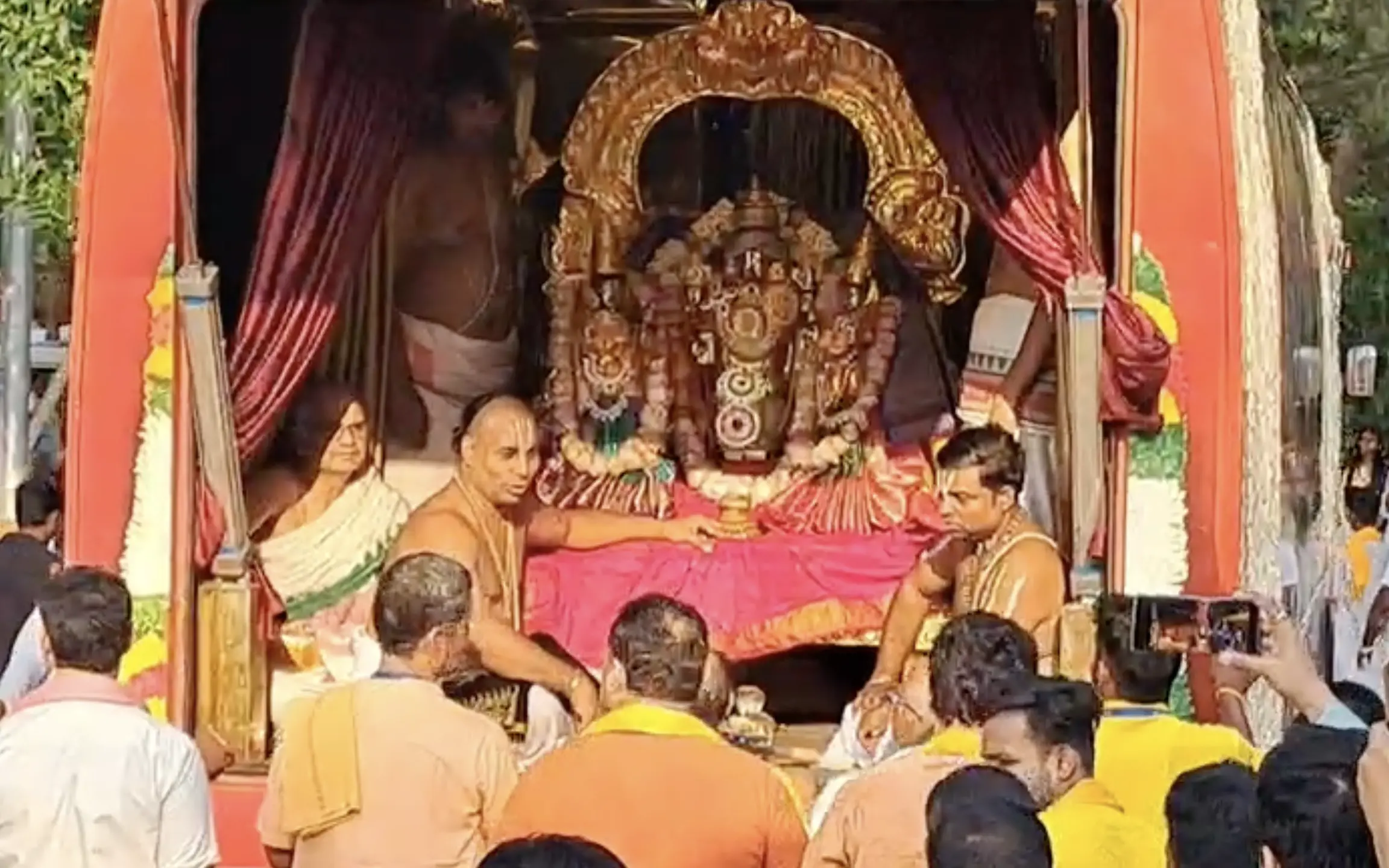
A Sacred Convergence of Yoga, Tradition and Cultural Memory
On the banks of the north-flowing Ganga, beneath a sky illuminated by hundreds of synchronized drones, the ancient town of Munger witnessed a spectacle that was devotional, cultural, and deeply symbolic at once.
As chants of “Govinda Govinda” echoed through the historic Yoga Nagari, thousands of devotees gathered not merely for a religious ceremony, but for an event that transformed the city into a living landscape of spiritual memory, ritual tradition, and public celebration.
What unfolded over two days during the Srinivasa Kalyanotsavam celebrations was far more than a routine religious gathering. It became a rare convergence of yoga heritage, South Indian temple tradition, civic participation, and modern cultural presentation.
The Legacy of Yoga Nagari
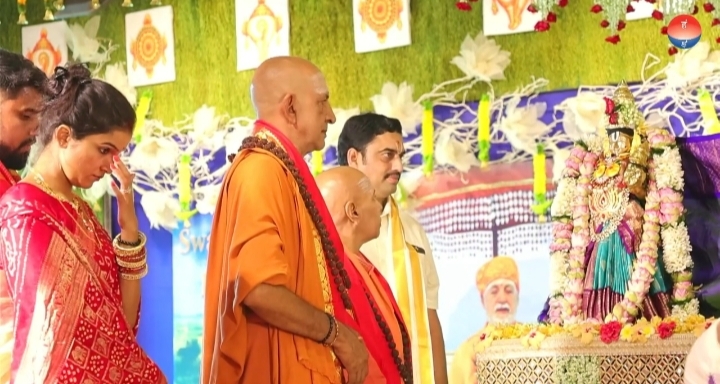
The celebrations marked 69 years since Swami Satyananda Saraswati first arrived in Munger as a wandering ascetic on May 6, 1957. According to spiritual tradition associated with the city, the north-flowing Ganga itself inspired his arrival in Munger.
It was here that he later established the Bihar School of Yoga in 1963, laying the foundation for a yoga movement that would eventually gain international recognition. Decades later, former President A. P. J. Abdul Kalam officially declared Munger as “Yoga Nagari” in 2005, acknowledging the city’s contribution to the global spread of yoga philosophy.
For many residents and followers of the Bihar yoga tradition, the annual observance of Swami Satyananda Saraswati’s arrival day is not only a spiritual event but also a reaffirmation of Munger’s identity as a city shaped by yogic thought and ascetic heritage.
When Tirupati Balaji Arrived in Bihar
This year’s celebrations carried an additional historic significance. For the first time, the festival idol of Lord Tirupati Balaji from Andhra Pradesh was brought to Bihar and installed for Paduka Darshan in Munger.
The idol became the focal point of devotion throughout the two-day programme as priests and scholars from Tirumala Tirupati Devasthanam conducted the Srinivasa Kalyanotsavam rituals according to traditional Vedic procedures. Thousands of devotees queued for darshan while elaborate rituals, chants, and ceremonial worship continued across the venue.
Bihar Chief Minister Samrat Choudhary visited Munger and offered prayers before the Balaji idol. Deputy Chief Minister Vijay Choudhary accompanied him during the ceremony. Union Minister Chirag Paswan, Khagaria MP Rajesh Verma, and Bihar Legislative Council Chairman Awadhesh Narayan Singh also participated in the celebrations.
Speaking on the occasion, Paramhansa Swami Niranjanananda Saraswati said that the birth centenary celebrations of Swami Satyananda Saraswati, which began in 2023, would continue until 2031 as “Padma Jayanti,” reflecting the spiritual importance of the number 108 in the ascetic tradition. He described the arrival of Tirupati Balaji in Munger during this commemorative phase as a moment of special significance for both Bihar and Munger.
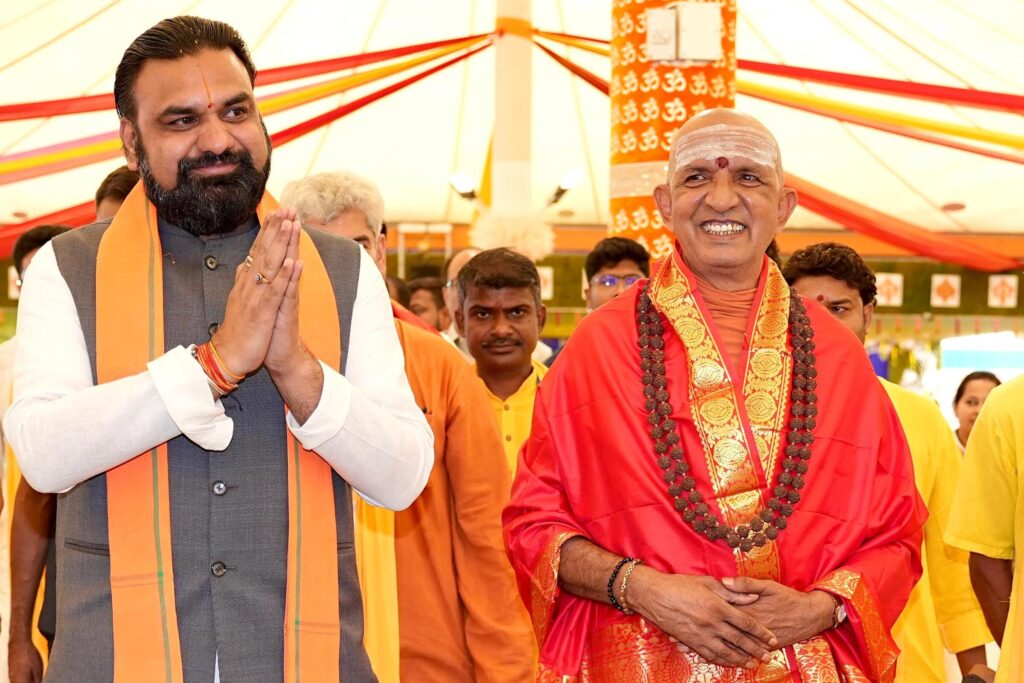
A Meeting of Sacred Traditions
Beyond the rituals themselves, the event carried a deeper cultural symbolism.
The arrival of Tirupati Balaji in Yoga Nagari represented a unique meeting of South Indian temple traditions and eastern India’s yogic and river-based spiritual culture. Priests from Tirupati temple conducted worship in the same ritual manner followed at the famous shrine in Andhra Pradesh, while devotees in Bihar participated with equal fervour.
The celebrations reflected how India’s spiritual traditions often transcend regional boundaries while still preserving their local identities. In Munger, devotional chants, Vedic rituals, yoga heritage, and public participation merged into a shared cultural experience rooted in continuity rather than uniformity.
Heritage Beneath a Drone-Lit Sky
One of the most visually striking moments of the celebrations emerged not from the temple grounds, but from the skies above Munger.
In a major initiative by the district administration, a grand drone show featuring 550 synchronized drones illuminated the city’s skyline. Drone formations recreated visual images of Munger Fort, Yoga Nagari, and the region’s mythological heritage, while laser lighting and giant screens projected scenes linked to the city’s historical legacy.
District Magistrate Nikhil Dhanraj Nippanikar said the objective of the event was to introduce younger generations to Munger’s rich historical and cultural heritage.
The spectacle reflected a changing language of heritage presentation in contemporary India, where ancient memory is increasingly being communicated through immersive public experiences, digital visuals, and civic participation.
A City Immersed in Devotion
On the second day, devotees from Munger and surrounding districts gathered from early morning at the Paduka Darshan site. Priests from Tirupati temple performed elaborate rituals for the Balaji festival idol, including Panchamrit bathing, ceremonial dressing, floral decoration, and traditional offerings in accordance with established temple customs.
Later in the evening, a grand procession carried Lord Venkateswara’s flower-decorated festival idol from Paduka Darshan to Polo Ground amid chants of “Govinda-Govinda” and “Vande Venkatesh.” Women from social and cultural organisations participated in traditional attire while singing auspicious songs. Along the route, devotees welcomed the procession with flower showers and devotional chants.
At Polo Ground, the idol was installed in a grand pavilion for public darshan, where thousands of devotees offered prayers and sought blessings. The entire Yoga Nagari region remained immersed in devotion, celebration, and spiritual enthusiasm throughout the event.
A Living Cultural Memory
Yet beyond the rituals, processions, and ceremonies, the larger significance of the celebrations lay in how Munger reaffirmed itself as a city of living spiritual memory.
Nearly seven decades after Swami Satyananda Saraswati first arrived on the banks of the Ganga, the city continues to preserve and reinterpret that legacy through new generations, new forms of participation, and new cultural expressions.
In Munger, ancient traditions were not presented as relics of the past. They were experienced as something living, evolving, and deeply connected to the cultural imagination of contemporary India.


Jharkhand lays foundation for film talent pipeline with SRFTI partnership

Jharkhand to Establish First Film and Television Institute with SRFTI

Jharkhand’s Moment on the National Stage: Santhali Film Angen Wins 72nd National Film Award

Palash: How Jharkhand’s Women’s Collective Became a Global Case Study

India International Mega Trade Fair 2026 in Ranchi

Jharkhand power bill to rise from April 1 as JSERC hikes electricity tariff

From Welfare to Enterprise: How Rs 2,500 a Month Is Helping Women Build Businesses in Koderma

Jharkhand’s Solar Policy: Decentralised Energy in Practice
